
Perceive live
Ingest cameras and archived video, then decode, redact, detect, and continuously track objects at the edge.
Continuously understand live video from warehouses, factories, and stores, turning changes involving people, equipment, and goods into searchable and actionable operational events.
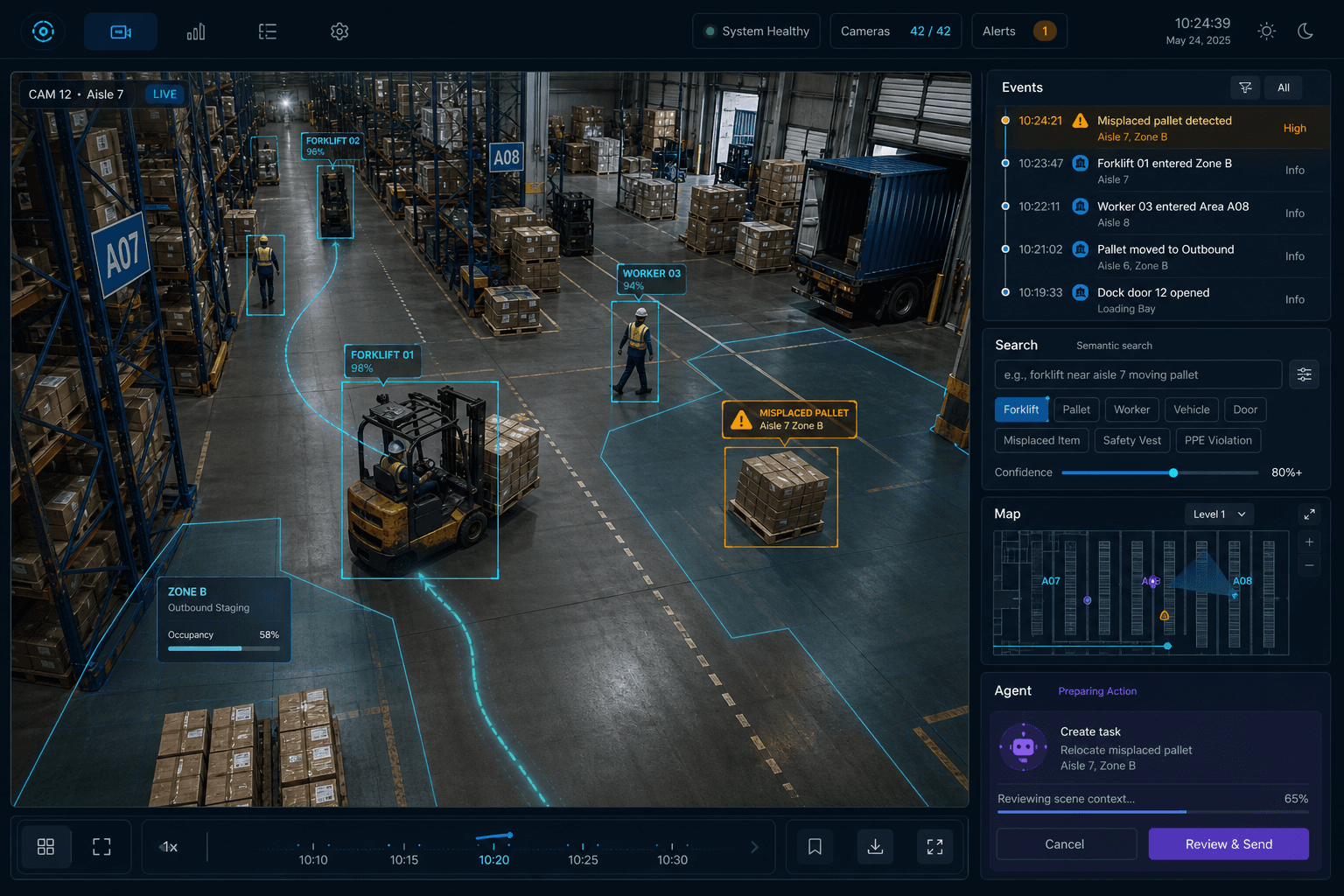
The platform ingests live and archived video, performs edge-side detection, cross-frame tracking, and privacy processing, then uses vision-language models to understand spatiotemporal relationships between workers, forklifts, pallets, and operating zones. Video events are correlated with BLE, RFID, IoT sensors, orders, and warehouse data. The Agent can retrieve key clips in natural language, build incident timelines, verify alerts, and use MCP tools to create work orders, notify owners, or trigger review workflows. High-risk events retain timestamps, trajectories, and business evidence for authorized human approval.
Reduce continuous manual screen monitoring and bring anomaly discovery, evidence retrieval, and coordinated response into one workflow while preserving real-time performance, traceability, and human control.
Ingest cameras and archived video, then decode, redact, detect, and continuously track objects at the edge.
Use VLMs to identify objects, actions, zones, and temporal relationships as searchable semantic events.
Fuse BLE, RFID, IoT, order, and warehouse data to verify visual events and reduce false positives.
Generate summaries and evidence, invoke MCP tools for work orders and notifications, and request approval for high-risk actions.
Hardware decoding, compact detectors, and tracking run continuously. Only anomalies selected by operational rules and business data reach the VLM, controlling GPU cost, response latency, and false positives by design.
Reuse existing RTSP / ONVIF cameras, ingest live streams at the edge, and retain raw recordings and incident clips according to access policy.
Batch multiple streams with hardware decoders such as NVDEC and adapt sampling to object speed and scene risk instead of sending every frame to a model.
Lightweight detectors continuously identify people, forklifts, pallets, and vehicles while trackers maintain IDs, trajectories, speed, and dwell time across frames.
Correlate zone crossings, dwell, and congestion rules with BLE, RFID, WMS, orders, and shift data, retaining only candidate events that need deeper explanation.
Analyze only key frames or short clips around an event to understand spatiotemporal relationships, explain the anomaly, and create semantic events with timestamps and evidence.
Retrieve evidence and invoke WMS, ticketing, and notification systems through MCP while keeping human approval and full audit trails for high-risk actions.
Switch between misplaced pallet, restricted-zone entry, and dock congestion to see tracking, VLM understanding, event search, and MCP actions in motion.